
Resources
Principles for authentic community engagement
To improve health for people with IDD, we must value the community's knowledge. This tool explains six guidelines for real community involvement. It also gives examples of each of the guidelines in real life and practical tips on how to use them. When we truly listen to and involve the IDD community, it leads to better health results.
About the principles
To create a healthcare system that works for everyone, we must:
--Involve people in real, meaningful ways--Build trust by taking action based on what they say
This "authentic engagement" is key to making care plans, research studies, policies, and programs that truly help improve the health and well-being of any community, including people with disabilities.
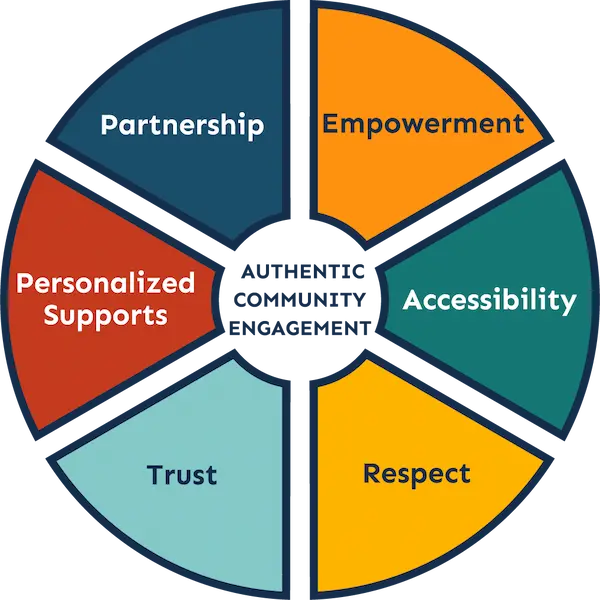
Principles of authentic community engagment
We organized the principles into six themes, as outlined below, and provided examples of how the principles worked in practice at a 2023 summit. Click to expand each.
Partnership
- Set clear rules and expectations for how everyone in the group should behave and work together. Read these out loud at the start of each meeting as a reminder of specific ways to show respect for people with IDD (PWIDD).
- Start meetings with fun activities to help people connect and see what they have in common.
- Help everyone feel equal and on the same level by using first names instead of professional titles or degrees.
- Encourage everyone to share their own perspectives and hear those of others.
- Learn together as a group and make decisions as a team to share power.
- Respect all types of knowledge, especially lived experience. Find clever ways to include everyone's input.
- Make sure everyone can fully participate. Some ways to do this are:
--Don't use complex words or abbreviations
--Use clear, simple language
--Provide support for different communication needs
--Be aware of sensitivities like loud sounds
What Partnership Looks Like
Bringing self-advocates and healthcare professionals together can be hard. One key strategy we used was creating group rules together with self-advocates. These rules remind everyone to:
--Include all
--Let everyone listen and be listened to
--Speak slowly and clearly
--Give time to think and respond
We read the rules at the start of each meeting. Everyone worked to follow them. If someone forgot, we:
--Sent a polite private message
--Asked them to pause or rephrase
--Suggested they get feedback
--Followed up one-on-one to remind them of the rules
This helped keep meetings inclusive, especially for self-advocates.
Empowerment
- Recognize people with intellectual and developmental disabilities (PWIDD) as experts: Actively ask for their insights and opinions and make sure to include and highlight their contributions.
- Look for ways to help each person in the community grow: Support them in developing their own special talents and boost their belief in themselves and what they can do
- Acknowledge questions – whether they are repeating previous discussions or raising challenging issues – and seek the opinions of all participants in conversations.
- Practice patience and allow people time to process information, consider options, form opinions, and share perspectives.
- Request input from PWIDD on all decisions and thank them for sharing their expertise and perspective. • Include PWIDD from the start of each phase of the project to co-design and co-plan core aspects of the work.
What Empowerment Looks Like
When all stakeholders play a role in the co-design, planning, and implementation of a project, it is more likely to meet its goals. In keeping with this philosophy, we established a Core Team and an Advisory Council. Both included equal numbers of members from each of the key stakeholder groups. The Core Team included one member from each stakeholder group and met monthly, supporting Project Leads with major project decisions and providing feedback on all matters. This regular collaboration ensures that the diverse perspectives and expertise of all stakeholders are integrated into project decision-making. The Advisory Council included several representatives from each stakeholder group and provided essential guidance, including on project deliverables.
Accessibility
- Identify everyone’s communication and accommodation preferences proactively to support full inclusion.
- Welcome all preferred methods of communication and create space in meetings to amplify perspectives that are shared by chat or Augmentative and Alternative Communication (AAC) devices.
- Create accessible materials using plain language, photos or other graphics with alt-text, and text-to-speech features, ensuring compatibility with screen readers.
- Ensure that in-person meeting spaces are wheelchair-accessible, accommodate sensory sensitivities, and provide other disability-related accommodations.
- Invite PWIDD to include their support person in meetings, prep calls, and project-related travel.
- Have a graphic facilitator at meetings to:
--Help everyone understand key health topics
--Explain terms, parts, and aims using visuals
--Make the discussions clearer and easier to follow
A graphic facilitator is a person who helps make meetings and discussions easier to understand by drawing pictures. They listen carefully to what people are saying and create visuals on large sheets of paper or a whiteboard.
What Accessibility Looks Like
To make our in-person meeting fully accessible, we:
--Worked closely with attendees
--Learned ADA rules aren't always enough
--Asked wheelchair users for their chair sizes
--Checked meeting spaces in person
--Measured doorways and hallways to fit two wheelchairs
--Made sure bathrooms and rooms had space to move around
--Brought a local person with IDD to give advice during site visits
We were proactive and collaborative to ensure true accessibility for all.
Respect
- Make key disability values central to everything: self-determination, civil rights, dignity, and community inclusion.
- Assume people with disabilities are capable. Don't underestimate what they can do.
- Describe people’s capabilities or support needs rather than describing a level of functioning or “severity” of IDD.
- Focus on fixing society, not people with disabilities.
- Learn each person’s preferred name, pronouns, and ways of interacting with others (for example, if they prefer to approach others first rather than be approached).
- Use language that respects each person's preferences about how they are identified in relation to their disability. This includes using identity-first language (like “autistic adults”) or person-first language (such as “person with Down syndrome”), unless someone prefers a different term. Use “non-speaking” instead of “non-verbal.” It’s important to learn and honor individual language preferences.
- See individuals as a person first. Be curious and interested in their personal stories and interests.
- Listen deeply with intention; pause for questions, comments, and requests for clarity; and check frequently for understanding.
- Promote diversity by making a special effort to include individuals from diverse backgrounds, such as people of color, queer identities, and those with varying IDD diagnoses, support needs, geographical locations, genders, and ages.
- Pay PWIDD equitably and fairly for their expertise (no less than $50/hr and higher if they take on leadership roles):
- Make sure you know who is the right person to sign forms and where payments should be sent or deposited.
- Be aware of income limits for public benefits and accommodate these restrictions when involving people with disabilities.
- Offer choices for payment, such as cash or a gift card.
- Include care partner/giver/rep payee on communications about payment, if preferred.
- Track hours spent on meetings, prep calls, and other preparation, and create draft invoices for PWIDD to review, sign, and submit.
What Respect Looks Like
At the start of our meetings, we always:
--Reviewed our values and rules
--Stressed respecting each person's choice of how to be identified
--Recognized different views exist, such as some prefer person-first language ("person with a disability") and others prefer identity-first language ("disabled person")
We made sure everyone knew to honor each individual's preference.
At a recent meeting with many different people, one of our self-advocate partners offered to talk more about this topic. We asked them to come up front and share their own view and experiences.
Using their own life as an example, they talked about how complex identity is. They said we should avoid putting people into strict categories. They shared that they are a non-binary, autistic person with an intellectual disability. They made the point that many people have multiple identities, so we shouldn't use rigid labels.
The 50 people in the room gave them a standing ovation. This showed the group's respect for what they shared and for them as an expert.
Trust
- Create a meeting space where everyone feels welcome and that they belong.
- Recognize the trauma, stigma, and bias that most PWIDD often face in the healthcare system and living in this society.
- Practice cultural humility. Work for self-awareness and recognition of one’s own implicit biases.
- Express empathy, not pity.
- Follow community members rather than lead them.
- Follow through on commitments in response to PWIDD’s input in a timely manner.
- Be self-reflective. Admit our mistakes and apologize as necessary.
- Gather input and feedback from PWIDD to help improve how we are doing.
What Trust Looks Like
We held individual meetings with each self-advocate to:
--Hear their personal health experiences
--Learn what good and bad health means to them
--Understand what's most important for their health
Almost all shared that in healthcare, they often faced stigma, bias, and trauma. Most said they rarely felt listened to. Many found that sharing their stories was very meaningful and helped restore some trust
Personalized Supports
- Offer one-on-one or small group prep calls to review materials before meetings, help self-advocates prepare their discussion points, and answer questions.
- Send individual calendar invites and other communications – such as reminders for meetings, follow-ups, and pending requests – according to a self-advocate’s preferences (for example: by phone, text, and/or email).
- Assist self-advocates as needed to review and fill out surveys, forms, travel arrangements, and financial documents.
- Record pre-meeting videos that give an overview of what to expect during upcoming meetings.
- Use plain language emails and materials with clear breaks and titles and language that meets the self-advocate’s needs.
- Use fewer written documents for people to respond. For example, use checkbox format or complete by phone.
What Personalized Supports Look Like
We created Easy Read and Plain Language materials, along with prep videos, and shared them before team meetings. We found that meeting one-on-one with self-advocates to prepare for upcoming meetings or receive their input on draft materials made sure they were fully included and engaged in the work. We ensured that they understood and were comfortable with the content, answered their questions, and encouraged them to share comments and feedback with us. We documented their feedback privately and then encouraged them to share their perspectives with the group during meetings.
Opportunities and Challenges in Growing
Truly involving community members with lived experience is key to creating a care system that focuses on what's most important to them and lets them be equal partners in finding better solutions.
To do this well, we need:
--Deep listening
--Support tailored to each person
--Communication that works for everyone
--Full accessibility based on individual needs
Building partnerships, trust, respect, empowerment, and empathy takes a lot of time and effort. It's not always possible to do everything for all community members in every project. But having clear principles and goals can still make a big difference by raising awareness of the barriers community members face in leadership roles and helping project leaders and policymakers understand these challenges.
Once they know, they can better use their staff, time, and money to provide the right support in each situation. Even small steps can help community members be more fully involved in shaping the care system.
Practical strategies for growing authentic engagement include:
- Train team members in the engagement guidelines to increase the number of sources of support.
- Create materials that can be easily updated to different uses. This includes email structure templates, standard invoicing forms, “tip sheets” that define commonly used terms in healthcare, and more.
- Coach self-advocates with skills to support other self-advocates.
- Use ChatGPT or other AI tools to produce Plain Language translations of key documents that are Section 504-compliant and accessible by screen readers. The translations can then be edited or illustrated to improve accessibility.
Help us reach our goals