
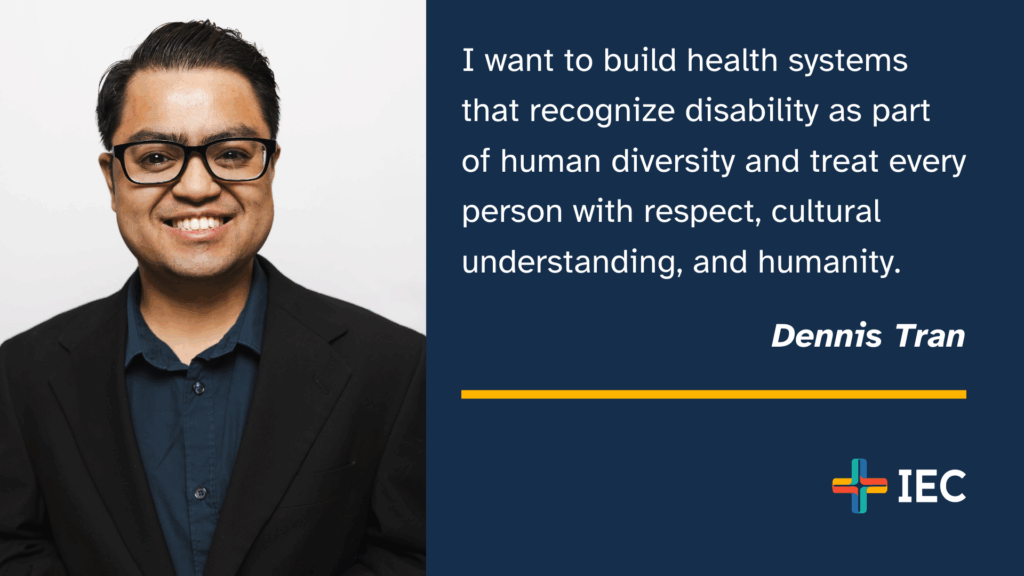
Dennis Tran knows what it’s like to feel unseen in healthcare.
Dennis grew up partially blind with chronic health conditions. He was not diagnosed with autism until age 27, and his ADHD diagnosis came even later. For years, doctors didn’t understand his needs. Dennis didn’t have the words to explain what he was experiencing, and the system wasn’t built to listen.
This is why IEC matters to Dennis.
When Dennis found IEC, he found a place where lived experience is treated as expertise. Through IEC’s Advocate Corps, Dennis helps shape healthcare to work better for people with intellectual and/or developmental disabilities (IDD).
“Being part of IEC reminds me that neurodiversity and disability aren’t obstacles; they’re sources of insight that can drive better care.” – Dennis Tran
Dennis hopes for a future where people with IDD lead change at every level of healthcare, and where no one is overlooked or dismissed for their disability.
Through the IDD Advocate Corps, Dennis works alongside other people with lived experience to improve training for healthcare providers, advocate for more accessible care, and ensure that people with disabilities are valued.
Here’s an interview we did with Dennis recently:
How did you first get connected to IEC?
I first heard about IEC through other IDD advocates in my network who introduced me to the organization and encouraged me to connect with Dr. Mai Pham. When I learned about the organization and her leadership in health innovation and her deep connection to the IDD community, it immediately resonated with my own journey. I’ve spent years working in digital health and health equity, long before I understood my own disability and neurodivergence. Once I was connected to Mai and learned about IEC’s mission, I knew this was a community where my lived experiences could inform meaningful systems change.
What has been your experience navigating medical systems, and why does IEC’s work matter to you?
Growing up partially blind with glaucoma, chronic conditions, and undiagnosed autism and ADHD, I faced constant barriers in healthcare, where providers who wasn’t aware or understood my needs, systems that lacked cultural understanding, and years of being misunderstood. My delayed and late diagnosis made navigating care especially challenging because I didn’t have the language or framework to explain what I was experiencing, being first diagnosed with glaucoma at 17, autism at 27, and then ADHD. IEC’s work matters because it centers people with lived experience and pushes for health systems that are culturally responsive, neurodiversity-affirming, and truly accessible to everyone, especially individuals with IDD.
How long have you been part of the Advocate Corps, and why did you decide to join?
I’ve been part of the Advocate Corps for over a year. I joined because I wanted to deepen my advocacy and expand the ways I could contribute to transforming healthcare. IEC was one of the few places where my lived experience wasn’t just seen as valuable, it was recognized as expertise. The Corps offered a space where I could grow my advocacy, while leading to co-create solutions that reflect the realities disabled people face every day.
Why is the Advocate Corps important to you?
The Advocate Corps gives me a sense of community, belonging, and responsibility. It’s one of the few spaces where disabled voices genuinely shape the direction of healthcare innovation. Being part of the Corps reminds me that my neurodivergence and disability aren’t obstacles; they’re sources of insight that can drive better care. It’s powerful to be in community with others who share similar experiences and are committed to changing what healthcare looks and feels like for disabled people.
What do you hope IEC will make possible in the future?
I hope IEC can continue building a healthcare ecosystem where IDD individuals lead at every level, from policy to design to direct service. I want to see systems where lived experience is integrated into provider training, where cultural and trauma-informed care is the baseline, and where late-identified disabled people are no longer overlooked or dismissed. Ultimately, I hope IEC helps shape a future where access, dignity, and equity are fundamental parts of care.
What is your personal hope for the future?
My personal hope is to help create the world I needed growing up. Through storytelling, research, and advocacy rooted in lived experience, I want to build health systems that recognize disability as part of human diversity and treat every person with respect, cultural understanding, and humanity. I want future generations, especially disabled and neurodivergent people from marginalized communities, to move through healthcare without the barriers I faced. Being part of IEC’s Advocate Corps gives me hope that this future is possible.