
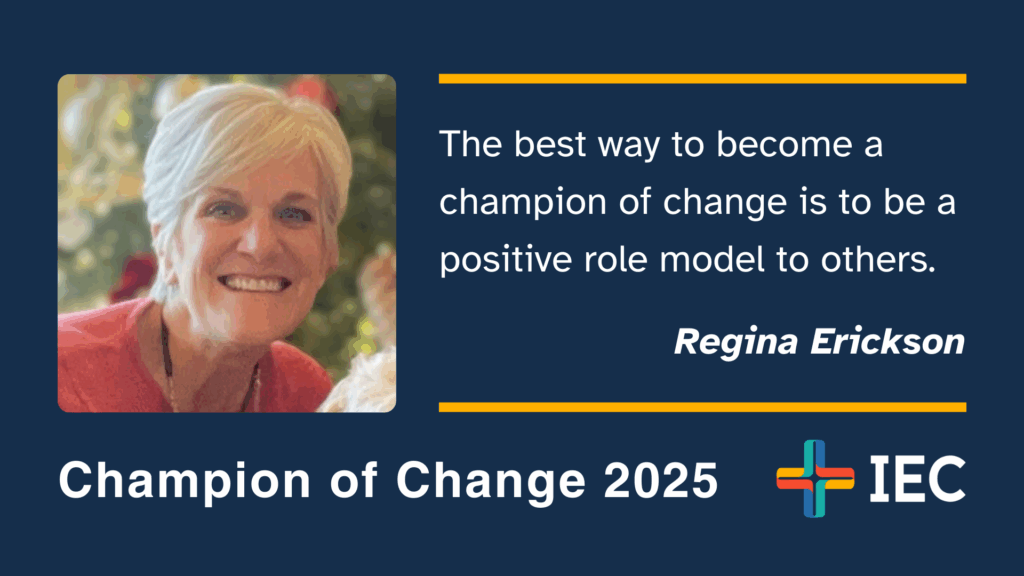
We’re delighted to announce Regina Erickson as IEC’s Champion of Change for 2025! Regina brings deep compassion, lifelong volunteerism, and powerful lived experience to her advocacy for people with intellectual and developmental disabilities (IDD).
Elyse has seen firsthaRegina’s connection to IEC is personal. As a mother of an adult son with IDD, she has spent decades navigating a complex healthcare and support system. Her medical background as a radiation therapist helped prepare her for these challenges, but it has still been a struggle at times.
Regina has helped IEC organize data, contacts, meeting notes, and much more. It’s the kind of behind-the-scenes work that often goes overlooked but is essential to keeping a small nonprofit like IEC running smoothly.
“Regina embodies the heart of our mission,” said Mai Pham, CEO of IEC. “Her lived experience, generosity, and unwavering commitment to people with IDD make her an inspiring Champion of Change. We’re honored to recognize her contributions.”
“IEC is remarkable in that it is bringing attention and creating change in the medical community for a demographic that often is overlooked.” – Regina
Read our full interview with Regina below.
1. What is your favorite food? What meal brings you the most joy? Why?
Food brings people together. Sharing a meal with others is so enriching-not only by providing sustenance, but also in building relationships through the conversations that take place. The meal that brings me the most joy is the meal I spend with my family.
I enjoy food and trying new things. Don’t know if I can say I have a favorite food, but I do have a bit of a sweet tooth. For instance, a warm chocolate chip cookie with ice cream is delicious.
I spend a lot of time in my kitchen cooking and baking for various groups. Currently, I am baking cookies for the annual cookie walk at our church. I also cook and serve in a monthly meal at a senior living center in my community.
2. What about IEC do you think is remarkable/unique?
IEC is remarkable in that it is bringing attention and creating change in the medical community for a demographic that often is overlooked. As the statistics show, those with IDD are less likely to receive the comprehensive medical/dental care that is needed. IEC is working to improve the healthcare system by how it is taught, delivered and paid for. I love the fact that IEC’s work centers on the lived experiences of individuals with IDD, and is led by self-advocates. The spectrum of those with IDD is very broad. While many may need comprehensive supports, there are many who could work. The opportunities to live independently and work are limited by not having a supportive community, and the resource limits placed on individuals restrict their ability to thrive on their own.
I chose to volunteer with IEC because of my daughter, Lauren. There was a need that she thought I could fulfill.
3. What in your background (professional or personal) drew you to IEC? Why did you choose to volunteer?
I was trained and worked as a radiation therapist at the University of Iowa and the Iowa City Cancer Treatment Center. I was also certified in Medical Dosimetry. While it has been years since working in this field, my training and work helped me to understand the medical community. My son was born with IDD, and because of my medical background, I was better prepared to meet the challenges of navigating the medical system. I later went back to college as a non-traditional student and got a degree in Psychology and a minor in Sociology. While my professional career kind of took a backseat to raising a family, I have worked many part-time jobs. I have been a caregiver for many. I have been a lifetime volunteer in my community through the school system (9 years as a school board member) and serving on numerous committees at my church.
4. Do you have a personal connection to IEC’s mission? If so, would you mind sharing it?
My son, Brian, has an IDD waiver. My lived experiences in advocating for him are numerous. The toughest question he has asked me is, “Why do people treat me differently.” He is now an adult-living independently, but he does need supports in decision making, finances, and transportation. My husband and I are his legal guardians, and I serve as his representative payee. Brian provides for himself, is responsible in his parttime job, and is saving money with his ABLE account. The journey for him has not always been easy. He does trust his family and chooses to have us as his primary caregivers. I will say there is a vast difference in the availability of resources between urban and rural communities. We made a move from my small hometown to a larger city because we believed it would provide more opportunities for him.
5. Which accomplishments or contributions, during your tenure with IEC, are you most proud of?
I am most proud of my contribution to IEC through my daughter, Lauren, and her work at IEC. She has built her career around making healthcare a better system based on her lived experiences as a sibling to someone with IDD. My participation in IEC involved data entry and meeting notes in Salesforce. This provides a way for all of you to keep track of the numerous conversations you have with so many different people across the country.
6. What kind of change do you envision for the world? What are your hopes for the future?
My idealistic nature envisions a world where labels are not used to differentiate people. I truly believe that everyone serves a purpose. We are all human beings with unique abilities. We all learn from one another and are meant to be in community with each other. The life lessons I learned through the patients I treated as a radiation therapist are numerous. Likewise, my son has taught me so much. They have made me a better person.
7. What can others do to become champions of change in their communities?
The best way to become a champion of change is to be a positive role model to others. Be a trusted individual. Build skills of communication that involve listening and empathizing with the concerns of other people. Change happens when we can effectively communicate the “how” and “why” a change is needed. We are all in this together. We all need to learn how to get along. Respect for each other needs to work in two directions.
Please join us in congratulating Regina Erickson, our IEC Champion of Change 2025, for her invaluable contributions and dedication to ensuring everyone has the respectful, person-centered care they deserve.
The IEC Champion of Change award honors individuals who embody IEC’s mission and have made outstanding contributions toward improving healthcare for people with intellectual and/or developmental disabilities (IDD). Recipients of this award demonstrate exceptional leadership, compassion, and dedication to advancing person-centered, equitable care and inspiring meaningful change in the healthcare system.